Pervaziv AI Adds Collections, Chat Forks and Governed Workflows, Advancing Cortex from Chat to Verified Work
Cortex organizes conversations, supports alternate paths, and carries eligible engineering work to reviewable results
Press Release Disclaimer: This is a press release distributed through the XPR Media network. It has not been independently verified by our newsroom.
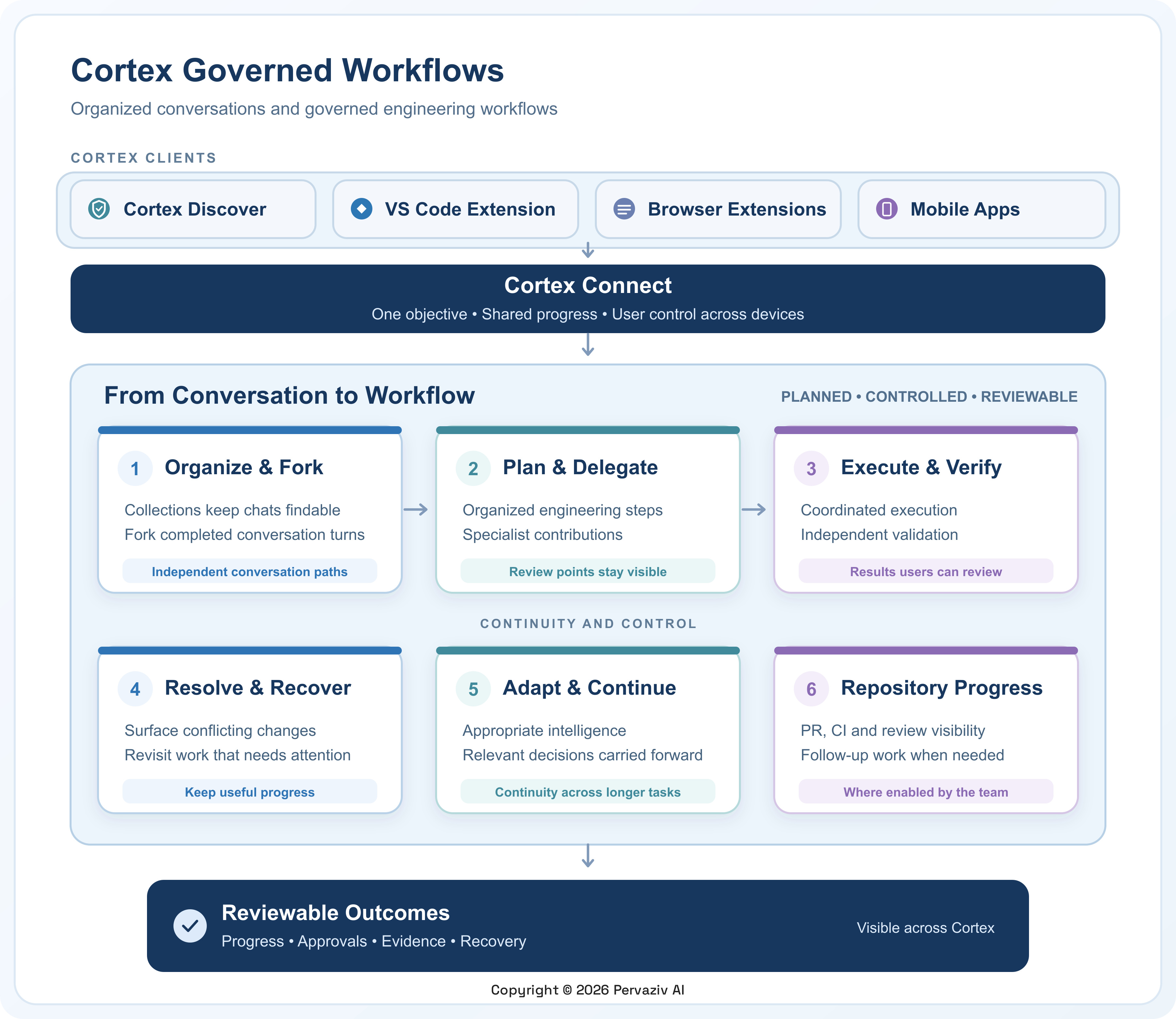

Cortex organizes conversations, supports alternate paths, and carries eligible engineering work to reviewable results with visible progress and validation.
SAN FRANCISCO, CA, UNITED STATES, September 24, 2026 /EINPresswire.com/ — Pervaziv AI today announced new capabilities in Cortex that connect the way users organize and explore AI conversations with the way engineering work is coordinated, reviewed, and completed.
The release introduces Chat Collections, Fork a Chat, and governed workflows for eligible engineering tasks. Together, the capabilities create a more coherent path from an initial question to work that can be inspected, continued, and reviewed.
Useful AI work rarely fits into one prompt. A question can become an investigation. An investigation can produce several possible approaches. One approach can then become an engineering task that requires implementation, testing, review, and a decision about what happens next.
Cortex now gives each part of that process a clearer role.
Chat Collections help users keep related discussions findable. Fork a Chat makes it possible to explore another direction from completed chat history without disturbing the original conversation. When a user chooses a direction that should become engineering work, Cortex can organize the objective into a durable workflow with specialized contributions, validation, visible progress, and review points.
The capabilities are connected, but they are intentionally different. A collection organizes conversations. A fork creates a separate conversation for exploration. A workflow coordinates and verifies actions against a project. Together, they help users move from an idea to work that remains understandable after the chat window closes.
Organize Work Without Losing the Conversation
———————————————————————
As people use AI across more projects, devices, and development environments, conversation history becomes part of the working environment itself.
A single software project can generate many useful discussions. One chat may investigate a defect. Another may explore architecture. A third may focus on an implementation request. A later conversation may review the result or revisit a decision after new information appears.
Without structure, those conversations can become difficult to find or easy to confuse.
Chat Collections give users a simple way to group related conversations and return to them as priorities change. Cortex supports that organization across its Visual Studio Code, browser, and mobile chat experiences.
The goal is not to force every conversation into one shared thread. Investigation, design, implementation, and review often need to remain distinct. Collections make it easier to preserve those distinctions while keeping related work together.
For users moving between devices or Cortex work surfaces, that organization also supports continuity. A conversation that began while reviewing a repository can remain easy to find later from another supported experience.
Explore Another Path Without Disturbing the Original
—————————————————————————
Engineering decisions often benefit from alternatives.
A developer may want to compare two fixes. A team may want to revisit an assumption made earlier in a design discussion. A security engineer may want to test a different remediation strategy without losing the analysis that produced the first approach.
Fork a Chat creates a new conversation from completed chat history, including from a selected completed response. The fork can continue independently while the original remains available.
That makes exploration easier without turning the conversation into a sequence of overwritten decisions.
Cortex also keeps the boundary between exploration and action clear. A fork is a conversation feature. It lets users examine another direction, compare ideas, or continue from an earlier point. Any engineering action that follows still goes through the normal Cortex workflow controls.
This separation is important because brainstorming and execution are not the same activity. Users should be able to explore freely before deciding which direction should become a request that changes a project.
Turn the Chosen Objective Into Coordinated Work
———————————————————————-
Once the user decides what should happen, the task changes from a conversation problem into a coordination problem.
An engineering request may require investigation before implementation. A code change may need tests. A larger change may require review, validation, or security checks before it should be considered complete.
For eligible requests, Cortex can organize those activities into a visible plan. Work can be sequenced around dependencies, while independent activities can move forward together when appropriate. Progress remains available if the user changes devices, leaves the task, or returns after an interruption.
Specialized Cortex capabilities contribute where they are useful, while permissions and review points remain part of the workflow.
If the task reveals additional work, Cortex can bring that need into the plan for review rather than leaving it buried inside a chat response.
For example, a feature request might begin with repository investigation, continue through a focused code change and tests, and then require a reviewer to decide whether the result meets the original objective. The user can follow that progression and see which decisions still remain outstanding.
This creates a clearer bridge between what the user asked for and what the system is doing on the user’s behalf.
Make Completion Depend on Evidence
———————————————————
One of the hardest problems in AI assisted engineering is deciding what complete actually means.
A convincing summary can sound finished even when the underlying work has not been checked. A code change may appear reasonable while a test still fails. An implementation may solve one part of the objective while introducing a new issue somewhere else.
Cortex can require evidence from the work performed and an independent check before a supported step moves forward.
Users can review what was checked and where attention is still needed. If validation is incomplete, or if the project has changed in a way that affects the result, the workflow can return to review instead of presenting an unsupported completion.
That changes the meaning of progress.
A completed step is not simply a persuasive statement in a chat transcript. It has a stronger basis because the result has been checked against the work that was actually performed.
This approach also reinforces an important principle across Cortex: AI should help move work forward without making it harder for people to understand why a result should be trusted.
Handle Change Without Losing the Whole Effort
———————————————————————
Longer engineering tasks rarely unfold exactly as first expected.
A new discovery can change the plan. Two changes can prove incompatible. An assumption can become invalid after a repository update. A test can show that an earlier decision needs to be revisited.
Cortex can surface those issues and bring affected work back under review.
The workflow can preserve useful progress while revisiting the parts that need correction. Results can be brought together for another check rather than turning every setback into an unexplained restart.
People remain involved in decisions that expand scope, reverse changes, or require additional judgment.
That matters for longer running work because the most useful outcome is not simply persistence. It is continuity with accountability. Users should be able to understand what changed, what remains valid, and what now needs another decision.
Match Resources to the Work
——————————————–
Different engineering requests need different levels of coordination.
A small change should remain responsive and should not inherit unnecessary workflow overhead. A larger task may require more specialized capabilities, more validation, or more time to reach a trustworthy result.
Cortex can adapt eligible work to available capacity and route it to appropriate intelligence within organizational controls.
That helps larger tasks make progress without requiring users to manage every model, execution detail, or coordination step themselves.
The same principle applies to the user experience. More capability should not automatically mean more complexity for the person making the request. The workflow should expose the progress and decisions that matter while keeping internal coordination manageable.
Remember the Decisions That Still Matter
————————————————————-
As work grows, the useful context is more than the latest chat messages.
A longer task may depend on earlier decisions, findings, assumptions, unresolved questions, or details discovered during implementation. If that context is lost, later work can drift away from the original objective or repeatedly rediscover the same information.
Cortex can carry forward relevant decisions, findings, and open questions so later work has the context needed to stay aligned.
When the project changes or an earlier assumption no longer holds, Cortex can revisit the affected context instead of blindly carrying it forward.
This allows work to continue after pauses, retries, or handoffs without asking the user to reconstruct the entire history each time.
It also fits with the broader Cortex approach to context management. Recent Cortex releases have addressed continuity, managed execution, context compaction, and inference reuse. Governed workflows extend that progression by focusing on which decisions and findings still matter to the work itself.
Continue Through Repository Events When Enabled
————————————————————————-
Engineering work often continues beyond the first implementation.
For repositories where the capability is enabled, Cortex can connect an active workflow to pull request, CI, review, and security progress.
Teams can see when checks finish, when more work is needed, and when a human decision remains outstanding. A failed check can become part of the continuing workflow instead of requiring the user to restart the task from the beginning.
Repository workflows follow configured controls.
Continuous work should fit a team’s existing review process and should keep responsibility for consequential decisions visible. The goal is not to bypass established engineering practices. It is to help users carry work through them with better continuity.
Keep People in the Loop Across Cortex
———————————————————
The conversation is where a user expresses intent. The workflow is where Cortex tracks execution, evidence, pauses, and decisions.
Task Center and connected workflow views help users understand what is running, what needs approval or review, and what result was reached across supported Cortex work surfaces.
That distinction becomes increasingly important as AI work lasts longer and crosses more environments.
A user may begin with a question in a browser, continue from Visual Studio Code, return from mobile, or use Cortex Cloud for managed execution. The work should remain understandable even when it outlives the device or screen where the original request began.
This release brings that experience closer together.
Users can organize related conversations, explore another idea without losing the first, choose which direction should become engineering work, and then follow that work through coordinated execution and validation.
A Clearer Line Between Ideas and Action
———————————————————–
The release also sharpens a boundary that becomes more important as AI systems take on more work. Conversation is useful for discovery, comparison, and judgment. Execution requires clearer controls, observable progress, and a way to show what actually happened.
Cortex is designed to preserve that distinction without forcing users to manually bridge it. A discussion can stay a discussion until the user decides it should become work. Once that happens, the workflow can make the next steps visible and bring the result back for review.
That helps keep experimentation flexible while making execution more accountable. It also gives teams a more consistent way to understand when AI is suggesting, when it is acting, and when a person still needs to decide what happens next.
One Cortex Experience Across the Work
———————————————————-
The value of these capabilities becomes more visible when they are used together.
A developer can keep related discussions in a Collection, fork a completed response to compare another approach, then choose the direction that should become an engineering request. Cortex can carry that request into a visible workflow, preserve the context that still matters, coordinate the contributing work, and surface the points where validation or human review is required.
That continuity is central to the Cortex experience. The user should not have to manually recreate the relationship between an earlier discussion and the engineering work that follows. At the same time, Cortex should not blur the distinction between brainstorming, execution, and approval.
By keeping those stages connected but explicit, Pervaziv AI is aiming to make agentic software development easier to follow as tasks become longer and more complex. The user can move between thinking, choosing, acting, checking, and reviewing without losing sight of the original objective.
Building on Cortex Connect, Cloud and Discover
———————————————————————
The new capabilities extend a broader Cortex architecture that has been evolving from isolated AI responses toward connected work.
Cortex Connect established continuity across supported mobile, browser, and Visual Studio Code experiences. Cortex Cloud added durable managed execution for eligible work that should continue beyond a local session. Cortex Discover brought Cortex into a dedicated agentic AI browser designed for governed enterprise work.
More recent Cortex releases added a three tier inference cache architecture for faster trusted AI workflows and expanded Cortex Cloud with static and runtime security across the software lifecycle.
Collections, Forks, and governed workflows address a different part of that same vision.
They focus on the path before and during execution: how users keep related ideas organized, explore competing directions, choose what should become work, and then follow that work through validation and review.
The result is a more complete connection between intent and outcome.
From Chat to Verified Work
—————————————–
The broader direction of AI assisted software development is moving beyond answers and code suggestions toward longer running work that can span investigation, implementation, testing, review, and follow up.
That shift creates a new requirement for the product experience.
Users need more than a powerful model. They need a way to organize the conversations that produce work, explore alternatives without losing history, understand what is happening after a task begins, and see whether the result was actually checked.
“The important shift in AI is from helping people think through work to helping them carry that work to an outcome they can inspect and trust,” said Anoop Jaishankar, Founder and CEO of Pervaziv AI. “Cortex connects the conversation, the chosen direction, the work that follows, and the evidence behind the result. The goal is to make AI more capable without making the work less understandable.”
That is the role of the new Cortex capabilities.
Collections give related conversations a place. Forks give users room to explore. Governed workflows help carry the selected objective forward with visible progress and validation.
Together, they create a clearer path from discussion to delivery while keeping people involved in the decisions that matter.
For developers, that can mean less time reconstructing intent as work changes shape. For engineering leaders, it creates a clearer view of how an AI initiated request moves toward a reviewable result. For security and platform teams, it keeps validation and review visible as AI participates in more of the software lifecycle.
The long term Cortex vision remains consistent: connect human intent, specialized intelligence, context, execution, security, and verification across the environments where work actually happens.
This release brings the conversation itself more directly into that architecture.
An idea can stay organized. An alternative can be explored. A chosen objective can become coordinated work. Progress can remain visible. The result can come back with evidence and a clear place for human review.
That is the path from chat to verified work.
Pervaziv AI
Pervaziv AI
email us here
Visit us on social media:
LinkedIn
Instagram
YouTube
X
Other
Legal Disclaimer:
EIN Presswire provides this news content “as is” without warranty of any kind. We do not accept any responsibility or liability
for the accuracy, content, images, videos, licenses, completeness, legality, or reliability of the information contained in this
article. If you have any complaints or copyright issues related to this article, kindly contact the author above.

Media gallery