
MLELE’s One-Stop Custom Modular Change-over Switch Solutions for Modern Infrastructure Projects
WENZHOU, ZHEJIANG, CHINA, November 17, 2026 /EINPresswire.com/ -- In transport hubs and commercial mixed-use
Press Release Disclaimer: This is a press release distributed through the XPR Media network. It has not been independently verified by our newsroom.
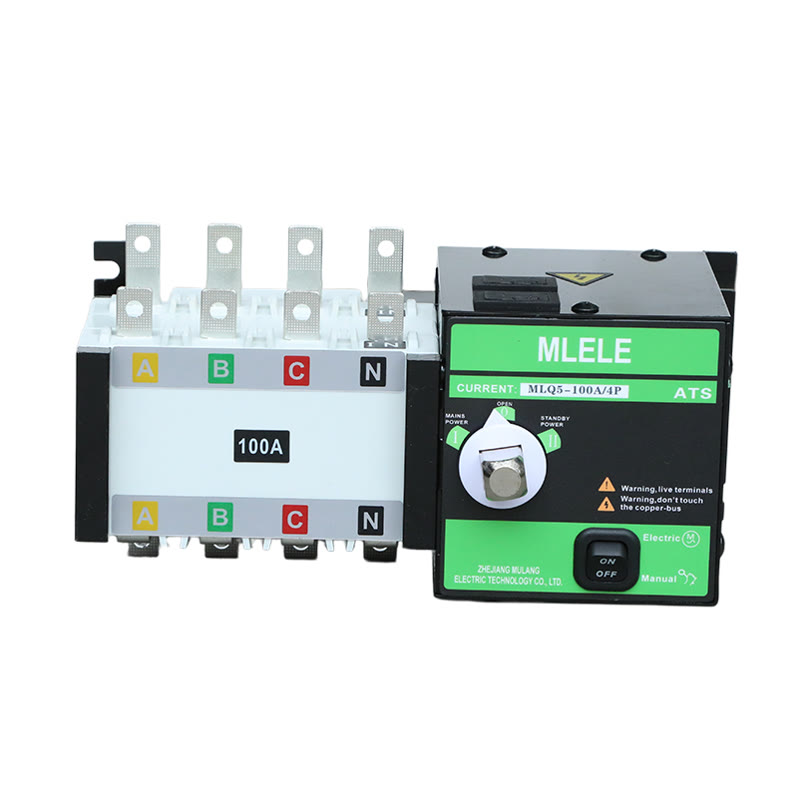

WENZHOU, ZHEJIANG, CHINA, November 17, 2026 /EINPresswire.com/ — In transport hubs and commercial mixed-use developments where continuity of service is essential, constrained electrical riser compartments dictate transfer gear engineered for compact footprint and smooth dual-source transitions. Emergency power schemes in these facilities confront limited switchgear depth, complex multi-feeder conduit entries, and the technical necessity of clean transfer between primary utility networks and secondary standby generators. Meeting these installation benchmarks centers on deploying custom-engineered automatic transfer switches designed to adapt to existing enclosure dimensions while preserving requisite electrical clearances. Within this specialized manufacturing domain, Zhejiang Mulang Electrical Technology Co., Ltd. (operating globally under the brand MLELE) supplies specialized low-voltage apparatus from its industrial production base established in 2010. By directing localized engineering and agile manufacturing toward custom modular change-over switches, the company provides international switchboard builders and mechanical-electrical contractors with customized modular transfer devices engineered to balance space efficiency and dynamic electrical protection.
Integrating customized switching systems into crowded electrical risers demands structural adaptation directly aligned with existing busbar arrangements and rated short-circuit withstand parameters. Customizing transfer switch topologies at the factory level enables panel fabricators to position connection terminals to match top, bottom, or lateral copper busbar entries, mitigating mechanical strain on internal conductors. By integrating the microcomputer logic controller board and motorized mechanism directly into the primary switch housing, this mechatronic construction removes the need for external electronic control cubicles, secondary control harnesses, and cabinet door penetrations. The embedded control module incorporates logic circuits that monitor incoming line voltages across three-phase systems. In parallel, dedicated potential-free auxiliary contacts and digital status communication ports feed real-time switch position telemetry, line availability statuses, and fault indication outputs directly into building management systems (BMS) over standardized low-voltage network interfaces, supporting centralized supervision across modern distribution facilities.
Wide Current Capacity and Dual Mounting Standard Adaptability
Adapting switching devices across modern infrastructure requires diverse physical mounting configurations and broad current-carrying capabilities. The modular transfer portfolio spans rated operational currents from 16A terminal branch protections up to 3200A heavy-duty main intake sections, covering single-phase 220V and three-phase 380V or 400V installations. For sub-distribution boards, building automation racks, and decentralized solar photovoltaic inverter change-over stations, compact DIN-rail mounted units provide standard 35mm top-hat rail fastening within the 16A to 125A bracket. These modular rail-mount switches maintain double-break isolation within miniature dimensions, speeding up field assembly inside standard modular consumer units. For central distribution rooms and heavy commercial risers, bolt-mounted change-over switches handling ratings from 250A up to 3200A feature reinforced copper terminal plates designed for direct connection with multi-laminated copper busbars, providing structural stability and verified short-time withstand currents ($I_{cw}$) reaching 50kA for 60ms.
This dual-mounting adaptability allows electrical contractors to standardize on a single engineering architecture across both primary distribution switchboards and decentralized sub-metering enclosures. Switch units operating in higher current brackets utilize silver-plated copper terminal pads with standardized bolt patterns, facilitating direct mating with standardized riser bus ducts. By offering both rail-mount and panel-mount chassis configurations, the product family accommodates varied enclosure depths, avoiding field modifications or mechanical re-drilling during on-site switchboard assembly.
Automatic Transfer Control Logic and Standby Generator Integration
Mission-critical infrastructure depends on automated operating logic capable of coordinating dual utility grids or utility-to-generator emergency setups. The intelligent microcomputer control system supports multiple programmable operating modes, including utility-to-utility self-input and self-recovery, utility-to-utility mutual standby, and utility-to-generator automated change-over. When incoming utility voltage drops below pre-calibrated operational margins or exhibits phase asymmetry, the controller initiates a factory-calibrated timing cycle to confirm persistent grid loss before triggering integrated normally open dry contacts connected to the standby diesel generator set. Following confirmation of stable generator voltage and rated frequency output, the motorized mechanism shifts the contact bridge to the standby source. Upon the re-establishment of stable primary grid parameters, the system executes a programmed transfer delay, returns the load to the primary supply, and maintains generator operation through an unloaded cooling sequence to protect engine turbos and alternator windings.
The internal microcomputer logic controller actively monitors three-phase voltage balance, phase loss conditions, and frequency stability on both incoming power feeds. Configurable potentiometers and digital programming interfaces allow site engineers to fine-tune transfer delay intervals from 0.5 to 30 seconds, preventing unnecessary switching during momentary utility voltage dips caused by large motor start-ups in neighboring industrial premises. An intermediate neutral off-position allows inductive motor fields to decay naturally prior to source reconnection, mitigating high transient peak currents that could trip upstream protective breakers.
Material Dielectric Endurance and Dynamic Thermal Stability
Transfer equipment installed in industrial environments must maintain dielectric integrity across broad ambient temperature extremes and harsh atmospheric conditions. The modular switch assemblies deliver steady mechanical and electrical performance across an operating ambient temperature boundary from -5 deg C to +40 deg C, with a permissible 24-hour daily average operating temperature of +35 deg C. The exterior insulating enclosure is hot-compression molded from premium unsaturated polyester resin reinforced with high-density glass fibers. This thermoset composite exhibits mechanical impact strength, self-extinguishing flame-retardant characteristics, and resistance to tracking caused by industrial airborne dust and ambient moisture. Internally, heavy-duty silver-alloy contact buttons control contact interface resistance, keeping operating temperature rises within standardized limits during continuous full-load conduction and mitigating contact welding during elevated transient short-circuit currents.
To verify dielectric isolation between adjacent phases and between live circuits and grounded structural enclosures, the switch maintains rated insulation voltage levels of 690V and 800V, alongside impulse withstand voltage ratings of 8kV. The multi-plate arc chutes split and de-ionize switching arcs within milliseconds, preserving the dielectric properties of internal air gaps even under repeated heavy inductive current transitions.
Differentiated Customization Engineering and Export Compliance
Fulfilling custom infrastructure tenders requires flexible production control aligned with physical switchboard dimensions. Leveraging precision fabrication capabilities in Liushi, MLELE adapts transfer terminal spreads and busbar hole patterns directly to project drawings under a certified ISO 9001 quality management framework. Switchboard builders can specify customized nameplates with laser-etched project tags, custom terminal pitch configurations, specified rated operating voltages, and specialized auxiliary contact sequences. Custom layout samples are prepared for mechanical verification within approximately 7 days, followed by commercial series fulfillment in 20 to 30 days after drawing approval. Export shipments are dispatched with official Certificates of Conformance (COC) and Certificates of Origin (Form E or CO), simplifying on-site electrical inspection and customs processing for international infrastructure works.
Coordinating modular transfer switches alongside MLELE’s catalog of over 2,000 low-voltage components, including molded-case circuit breakers (MCCB), air circuit breakers (ACB), and surge protective devices (SPD), provides electrical engineers with unified distribution protection. Visit the official global web portal to review complete engineering specifications, obtain dimensional CAD drawings, and consult directly with factory technical engineers regarding customized switchgear requirements:
Zhejiang Mulang Electrical Technology Co., Ltd.
MLELE
Visit us on social media:
Facebook
Legal Disclaimer:
EIN Presswire provides this news content “as is” without warranty of any kind. We do not accept any responsibility or liability
for the accuracy, content, images, videos, licenses, completeness, legality, or reliability of the information contained in this
article. If you have any complaints or copyright issues related to this article, kindly contact the author above.

Media gallery
